 Loading... Please wait...
- Home
- Shop Products
-
Resources
- 3i compatible external hex abutment selection guide
- Bicon Compatible Abutment Selection Guide
- ZimVie TSX and TSV compatible abutment selection guide
- 3i certain compatible abutment selection guide
- Implant Locator Pin Guide
- Why Titan Implants
- The One Driver Advantage
- Signature Products
- Selection Guides
- Specialty Solutions
- FAQ
-
Educational Videos
- Company
- President's Statement
-
Contact Us
Shop Products
Implant Systems
Biomet 3i Compatible
Nobel Biocare Compatible
Zimmer Dental & ZimVie Compatible
ITI-Straumann Compatible
BioHorizons Compatible
Astra Tech Compatible
Bicon Compatible
Friadent Frialit and XiVE Compatible
STERI-OSS Compatible
Calcitek Compatible
Keystone (Lifecore) Dental Compatible
Core-Vent Compatible
Paragon Compatible
Centerpulse Compatible
IMZ Compatible
IMTEC Systems Compatible
BioLok Compatible
Innova-Corp Compatible
Impla-Med Sterngold Compatible
Osteo Implant Corporation Compatible
( ADI ) American Dental Implant Corp. Compatible
Swiss Implants, Inc. Compatible
The Spectra System Compatible
Shop by Component
Abutments & Attachments
- All abutments & attachments
- Straight Abutments
- Multi-Unit Abutments
- Multi-Unit Abutment Attachments (NB Interface)
- Conical Abutment Attachments
- Modifiable Preppable Abutments
- Titan Design Ex Hex Simple Step Abutments
- Temporary Abutments
- Titanium Bar Abutments for Laser Welding
- Overdenture Ball Abutments
- Non-Engaging Post Abutments One Piece
- Solid Abutments for Tissue Level Implants
Healing & Surgical
Impression & Lab Components
Accessories & Extras
- Home
- Implant Systems & Compatibles
- Biomet 3i Compatible
- External Hex
- 5.0mm Seating Surface Implant Attachments
- Straight Abutments
- ZimVie Biomet 3i Compatible External Hex 5.0mm Seating Surface Simple Step Abutments With Titanium Screw (T-5ESA)
ZimVie Biomet 3i Compatible External Hex 5.0mm Seating Surface Simple Step Abutments With Titanium Screw (T-5ESA)



Product Description
The Simple Step Abutment is a Titan Implants exclusive. It replaces the flat side of a conventional straight abutment with a hexed prep surface and machines the emergence profile into the abutment itself, so a single stock part covers cases that would otherwise call for a custom component. This is the engaging version for ZimVie / Biomet 3i external hex implants with a 5.0mm seating surface.
Specifications
- SKU: T-5ESA
- Compatibility: ZimVie / Biomet 3i external hex, 5.0mm seating surface
- Component: Simple Step Abutment (Titan exclusive)
- Engagement: Engaging (hexed) — single units and splinted multi-unit
- Retention: Cement-retained
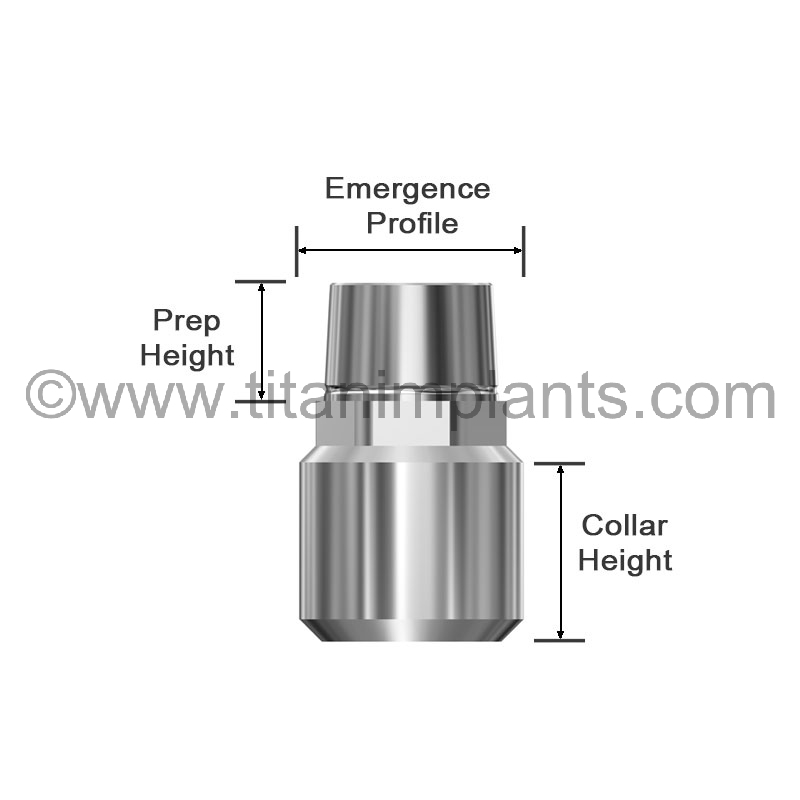
- Prep heights: 4.0mm, 5.5mm, 7.0mm
- Collar heights: 2.0mm and 4.0mm
- Emergence profile diameters: 5.0mm and 6.0mm
- Material: Grade 23 ELI titanium (Ti-6Al-4V ELI), ASTM F136
- Includes: Titanium retaining screw
- Driver: 0.050" hex driver required (sold separately)
- Manufactured by: Titan Implants, Inc. — Bergenfield, New Jersey, USA
What the stepped design does
- Emergence profile is machined in. Several flare diameters let the abutment follow the root form of the tooth being replaced, giving a continuous transition from the implant platform to the crown margin.
- Hexed prep instead of a flat side. The hex geometry is anti-rotational and adds surface area for crown retention, holding the abutment oriented through crown fabrication and cementation.
- Two collar heights. Collar selection places the abutment margin at the depth the case calls for relative to the gingival crest, and can be matched to tissue thickness or implant placement depth.
- Three prep heights. Selecting the prep height up front reduces chairside adjustment.
- Stock part, custom-like range. The prep height, collar height, and emergence profile combinations cover a wide span of cases, often avoiding the cost and turnaround of a custom or CAD/CAM abutment.
Simple Step or Straight Locking Abutment?
Titan offers two straight abutments for 5.0mm platform external hex implants.
- Straight Locking Implant Abutment Flat (SLIAF) — flat side, standard 8mm prep height, collar heights 1–4mm, 6.0mm emergence profile. Choose it when a defined collar height sets your margin without preparation.
- Simple Step Abutment — hexed prep, prep heights 4.0 / 5.5 / 7.0mm, collar heights 2 and 4mm, emergence profiles 5.0 and 6.0mm. Choose it when crown retention and orientation are the concern, or when you want the prep height selected rather than reduced chairside.
Selecting the right size
Emergence profile diameter
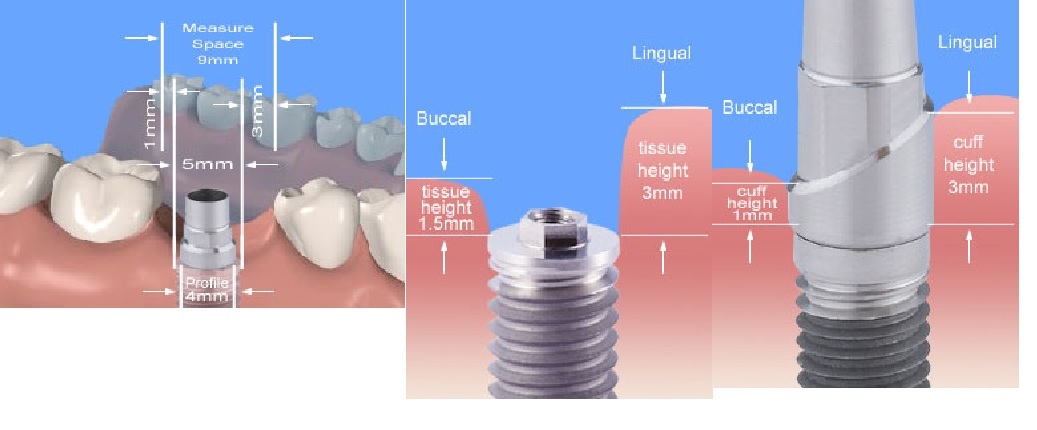
Measure the available space between the proximal surfaces of the teeth adjacent to the edentulous area, then subtract two millimeters — at least one millimeter is needed between the abutment flare and each adjacent root surface. That gives the maximum abutment diameter for the space. If more than 1mm is available on each side, move up to the larger emergence profile diameter.
Prep height
Measure the space between the gingival crest and the opposing tooth, then subtract three millimeters. That gives the proper abutment height.
Collar height
Measure from the implant platform to the crest of the gingiva on both the buccal and the lingual, and take the higher number (usually the buccal). Subtract ½ to 1mm so the collar sits slightly below the gingival crest, then choose the closest available collar height. If buccal and lingual differ and you want to follow the gingival contour, modify the collar accordingly.
Tip: the best results come from taking a tissue model impression of the implant with a transfer coping. The lab can then select and modify the right abutment for the available space.
Recommended accessory
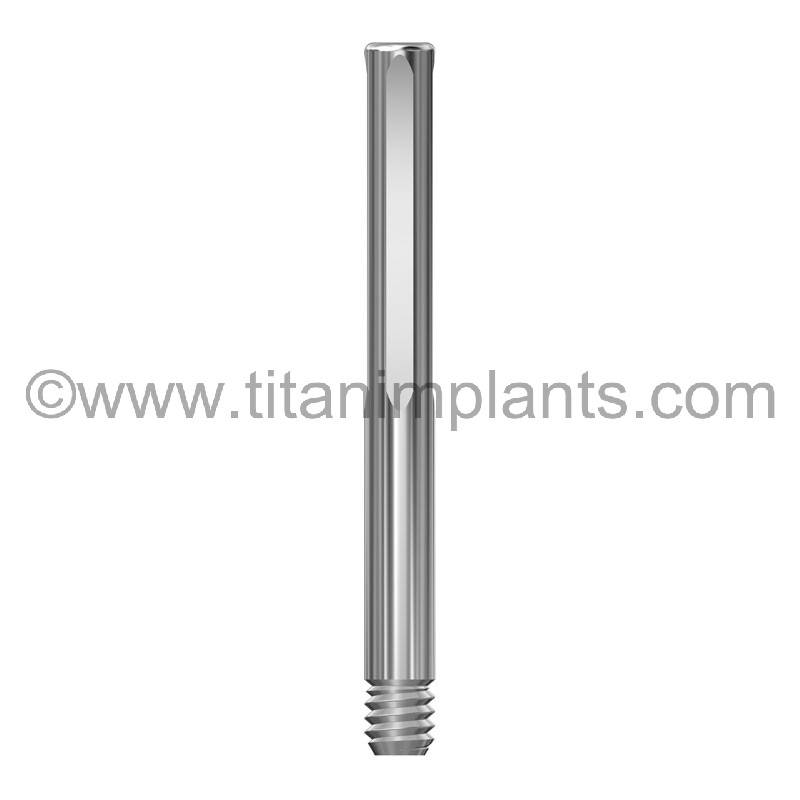
The Titan Implant Locator Pin is a threaded pin with a serrated handle that screws into the implant by hand. Use it to seat components where visibility or access is restricted, and to check implant parallelism and positioning. See it in use.
Manufacturing and quality
Machined in Bergenfield, New Jersey from Grade 23 ELI titanium and dimensionally inspected against our controlled drawings. Titan Implants has manufactured compatible restorative components for active and legacy implant systems since 2000.
Shipping: ships in 1–2 business days from our Bergenfield, New Jersey facility. Free shipping on orders over $199.
Biomet 3i® and ZimVie® are registered trademarks of their respective owners. Titan Implants, Inc. is not affiliated with, endorsed by, or sponsored by ZimVie or Biomet 3i. This component is manufactured by Titan Implants, Inc. and is machined to the referenced system's original prosthetic specifications. Trademarks are referenced solely to identify implant compatibility.
See the technique: See the Simple Step seating and impression technique
Other Details
Add to Wish List
You Recently Viewed...
|
Note: All pictures are not sized to scale. All prices are in USD. All prices and product availability subject to change without prior notice. Titan Implants® is a trademark of Titan Implants, Inc., | |||||
|
Branemark System®, MirusCone™ and EsthetiCone®, Sterioss®, Nobel Active®, and NobelReplace®, Tapered and Straight Groovy, Nobel Speedy®, Replace™, Replace Select™ Tapered and Straight, Sterioss™, HL Series, Flat Top, Replace™ External Hex, Unigrip, WP, and RP are registered trademarks of Nobel Biocare. 3i®, Biomet®, Biomet 3i™, Certain®, Miniplant®, NanoTite™, Osseotite®, Osseotite XP® and Prevail®, MicroMiniplant®, and Immediate Occlusal Loading® are trademarks of Biomet 3i, Inc. 3i TG® is a registered trademark of 3i Implant Innovations Inc. Frialit-2®, XIVE®, and Friadent® are registered trademarks of Dentsply Friadent Group. OTI Systems® is a registered trademark of Osteo- Implant Corporation. Micro-Lok® and Silhouette Laser-Lok® are registered trademarks of Bio-Lok International Inc. IMTEC®, Endure® and Universal® Implants are registered trademarks of Imtec 3M Corporation. Lifecore® is a registered trademark of Lifecore Biomedical Group. Lifecore®, RESTORE, SD, RD, WD, Renova®, SDI, WDI, Stage-1, RDS, and WDS are registered trademarks of Keystone Dental. Solid Abutment, SCS, and SynOcta® are registered trademarks of ITI-Straumann®. Screw-Vent®, Tapered Screw-Vent®, Spectra Cone®, Tapered Collar®, Advent®, Taper-Lock®, SwissPlus®, and Micro-Vent™, Bio-Vent®, Core-Vent®, Spectra Cone®,(The Spectra System®) are registered trademarks of Paragon Dental. Paragon®, Screw-Vent®, Tapered Screw-Vent®, Advent®, SwissPlus®, and Spline® Implants are registered trademarks of Zimmer Dental. One Stage®, and Endopore ® are registered trademarks of Innova Corporation. BioHorizons™ is a trademark of BioHorizons USA Implant Systems Inc. Sterioss, HL Series, Flat Top, Replace, Replace-Select, are registered trademarks of Nobel Biocare AB. IMZ® is a registered trademarks of FRIATEC systems. MicroThread™ and Conical Seal Design™ are registered trademarks of Astra-Tech Dental. Astra Tech Inc. is a registered trademark of DENTSPLY Implants. Bicon™ is a registered trademark of Bicon Dental Inc. INTEGRAL® and OMNILOC® are registered trademarks of Calcitek®. Spiralite® and Bonelock® Implants, Rootform® Flat Top Abutments and Hex-Top Abutments are registered trademarks of Swiss Implants Inc. Sterngold-ImplaMed® is a trademark of Sterngold Dental, LLC. American Dental Implant is a trademark of American Dental Implant Corporation. |
|||||
| Contact Us at : 1-201-439-0470 Or call us at : 201-439-0026 Customer service hours 8:30am - 5:00pm EST, Monday through Friday (Our clients are dentists and lab technicians. We do not work with patients.) |
|||||
We ship by  |
We Accept  |
| |||

Copyright 2026 Titan Implants, Inc. - All rights reserved.
